Zinc helps create amino acids like tryptophan. IAA and auxins, growth hormones, are made from tryptophan. This is crucial for addressing plant stunting.
1- Flowering Process: Zinc helps flower stamens generate pollen grains.
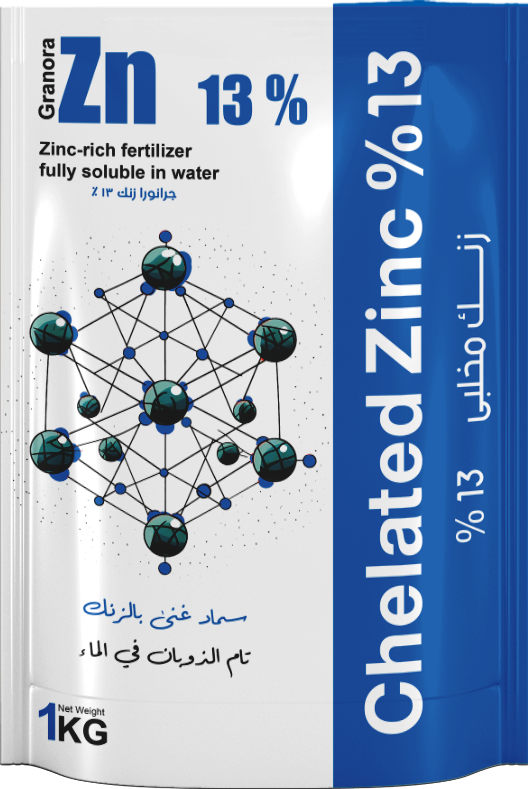
2- Granora Zinc %13″ supplies plants with zinc, important for physiological processes.
Chemical Composition :
| Chelated Zinc | 13% |
The properties of the compound:
Granora Zinc 13% works to nourish plants with the essential element zinc in:1- Formation of the amino acid tryptophan, which is used to produce indole-3-acetic acid and elongation auxins. Thus, the compound is essential in treating cases of plant dwarfism.
2- Flowering process, as zinc plays a crucial role in the germination of pollen grains on the stigmas of flowers.
3- Increasing productivity in grain crops such as corn and barley, as well as in fruit trees such as citrus, loquat, and apple, due to its essential role in increasing branching.
4- Activation of important plant enzymes and promotion of hormone growth, leading to early fruit ripening.
5- Photosynthetic processes, as it is involved in chlorophyll formation in plants.
1- Small leaf size and yellowing between the veins, especially in newly grown leaves.
2- Irregular leaf shape, twisting, crowding on small branches, and plant dwarfism.
3- Death of branches from the top towards the base and low seed yield.
Granora Zinc 13% is free from sulfates, carbonates, and chlorides, allowing it to be used for foliar spray or added to irrigation water without causing any harm to the plant.
Rates of use:
The dosage is 0.5 to 1 kg per acre.
It is recommended to repeat the spraying every one to two weeks in cases of severe deficiency, especially on fruit crops, field crops, and vegetables.
Usage rates may vary depending on climatic conditions, soil type, and recommendations from the specialized consultant.