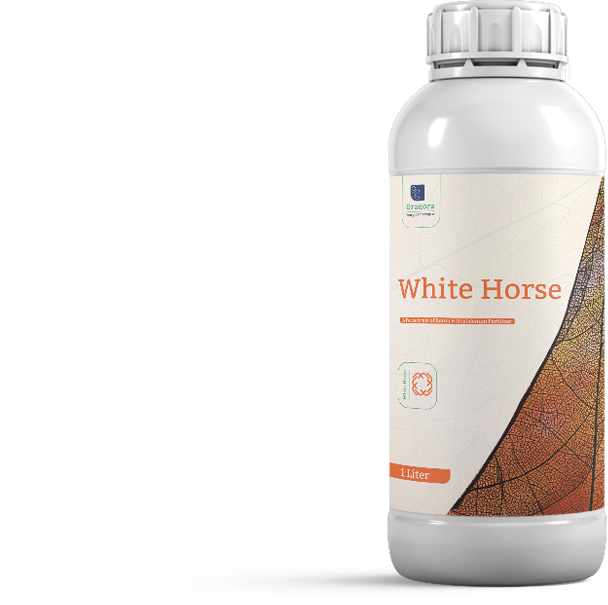
High amounts of boron and molybdenum in this chemical protect plants against micronutrient deficits like:
1- Mesh yellowing and calcification in young leaves: Improves leaf health by preventing them.
2- Leaf spots and burning symptoms: Preserves plant attractiveness by reducing damage.
3- Reducing apical bud deformation, retrograde drying at branch terminals, and internode shortening.
Chemical Composition :
| Boron | 11% |
| Molybdenum | 0.5% |
| Ascorbic acid | 1% |
The properties of the compound:
It contains a high percentage of boron and molybdenum, which protects plants from damage caused by a lack of minor elements, such as symptoms of interveinal yellowing and calcification in young leaves, spotting and burning of leaves, distortion of apical buds, or the occurrence of reverse drying at the tips of branches and shortening of internodes, as well as the small size and reddening of young leaves.
It improves the growth and firmness of grain crops like rice and wheat.
It stimulates enzymatic processes and natural growth hormones in plants, resulting in faster growth rates, flowering and fruiting, and higher yields. It also increases the efficiency of pollination and fertilization, as well as the number of nodes, resulting in full and strong grains.
It addresses the hollow heart phenomena in tubers, as well as heart rot in sugar beets, cabbage, and cauliflower.
It consolidates sugar storage in fruit trees, sugar beets, and vegetable crops.
It dissolves quickly in water and has an acidic effect.
Rates of use:
For flowering and nodulation, use 0.5 liters per 400 liters of water two weeks before spike emergence, as with wheat, barley, and maize. Also, when the first blossom appears in sugar beets, and when flowering begins in vegetable crops at the full nodulation stage.
Sugar beets and onions require 30 days before harvesting.
Application rates may differ depending on meteorological circumstances, soil type, and advice from a trained consultant.